How to Read Your ComEd Bill: Every Charge Explained
Supply, Delivery, Taxes — What Each Line Item Means and Where Your Money Goes
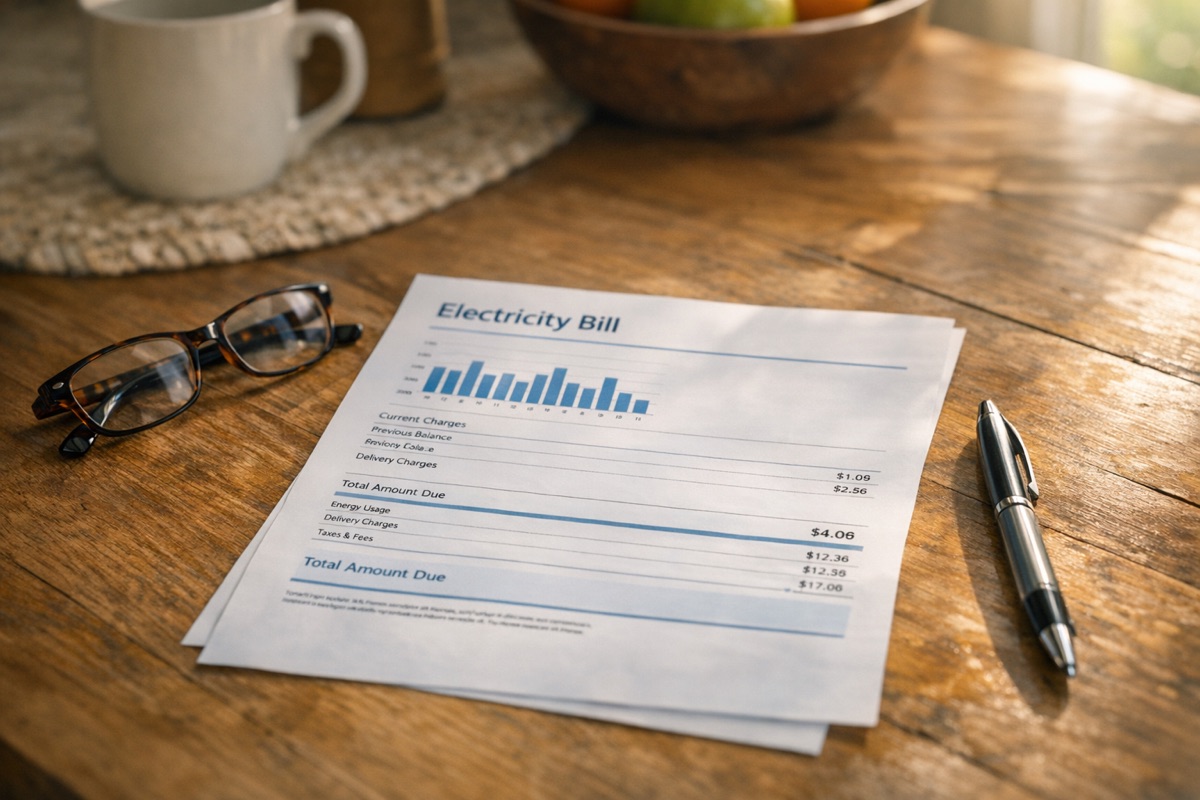
Your ComEd bill arrives every month, and every month it looks like a wall of cryptic line items. Supply charges, delivery charges, capacity obligations, purchased electricity adjustments — it's a lot. But each charge has a specific purpose, and understanding them puts you in control of your electricity spending.
This guide walks through every section of a standard ComEd residential bill, from the account summary on page one to the itemized charges on the back. By the end, you'll know exactly where your money goes — and where you have room to save.
The Bill Formula: Three Buckets
Every ComEd bill boils down to one formula:
Supply is the cost of the electricity itself. Delivery is the cost of moving it from the power plant to your home over ComEd's wires. Taxes and fees are state-mandated charges and surcharges. Supply typically makes up about half to two-thirds of your total bill, with delivery covering most of the rest.
Page One: The Summary
The front page of your ComEd bill gives you the high-level picture. Here's what each section contains:
Account Information
Your name, service address, account number, and the billing period dates. Double-check your service address — if ComEd has the wrong location, your bill could reflect incorrect rate classifications.
Amount Due & Due Date
The total you owe and when payment is due. ComEd typically gives about 21 days from the bill issue date. Late payments incur a 1.5% monthly penalty, so setting up autopay is worth it.
Usage History Graph
A 13-month bar chart showing your kilowatt-hour (kWh) consumption over time. This is one of the most useful sections on the bill — it lets you spot seasonal trends and catch unusual spikes. Look for the word "Actual" next to the meter reading. If it says "Estimated," ComEd didn't read your meter that month and guessed your usage based on history.
Usage Comparison
Shows your current month's usage alongside last month and the same month a year ago, along with average daily temperature. This helps you understand whether a high bill is driven by more usage (running the AC harder) or higher rates.
Electricity Supply Charges: What You Pay for Power
The supply section covers the cost of generating and transmitting the electricity you consume. If you're on ComEd's default rate (most customers are), this section will list "ComEd" as your supplier. If you've signed up with an alternative retail electric supplier (ARES), their name appears here instead.
| Line Item | What It Covers | How It's Charged |
|---|---|---|
| Electricity Supply Charge | The base cost of the electricity you used during the billing period. This is the "Price to Compare" — the rate you'd need to beat if shopping for an alternative supplier. | Per kWh |
| Transmission Services Charge | Covers the cost of moving electricity over high-voltage transmission lines from generators to ComEd's local distribution network. All customers pay this, even with an alternative supplier. | Per kWh |
| Capacity Charge | The cost of reserving enough generating capacity to meet peak demand. Think of it as "insurance" that power will be available on the hottest summer afternoons. Changes every June based on PJM auction results. | Per kW (based on your peak usage) |
| Purchased Electricity Adjustment | A reconciliation charge (or credit) that accounts for the difference between what ComEd collected from customers and what it actually paid for electricity. This can go either way — if ComEd overpaid, you'll see a charge; if it overcollected, you'll see a credit. | Per kWh (can be negative) |
Key Point: ComEd Doesn't Profit on Supply
By law, ComEd must pass through supply costs at cost with no markup. The supply rate on your bill is exactly what ComEd pays on the wholesale market. This is why the "Price to Compare" exists — it's the benchmark for evaluating alternative supplier offers.
The Capacity Charge: A Closer Look
The capacity charge deserves special attention because it's been a major driver of rising ComEd bills. Here's how it works:
Each customer has a capacity obligation — a kilowatt (kW) value representing your expected usage during peak summer demand hours. ComEd multiplies this by the capacity charge rate, which is set by PJM Interconnection's annual capacity auction.
Capacity Obligation (kW) × Capacity Rate ($/kW) = Your Monthly Capacity Charge
Example: 2.51 kW × $10.11/kW ≈ $25.38/month
If you're on ComEd's standard flat rate, the capacity charge is bundled into your per-kWh supply price — you won't see it as a separate line item. But if you're on ComEd Hourly Pricing, it shows up as its own line.
Delivery Charges: Getting Electricity to Your Door
No matter who supplies your electricity, ComEd owns and operates the poles, wires, transformers, and meters that deliver it. The delivery section covers these infrastructure costs. You pay delivery charges to ComEd regardless of your supplier choice.
| Line Item | What It Covers | 2026 Rate |
|---|---|---|
| Monthly Customer Charge | A flat fee covering ComEd's administrative costs: billing, customer service, postage, and system maintenance. You pay this even if you use zero electricity. | $15.26/mo* |
| Standard Metering Charge | Covers the cost of your smart meter — installation, maintenance, and the communication network that transmits your usage data to ComEd. | $3.81/mo* |
| Distribution Facilities Charge | The biggest delivery charge. Covers maintaining and upgrading local power lines, transformers, substations, and other equipment in your area. | 6.228¢/kWh* |
| IL Electricity Distribution Tax | A state tax on electricity distribution, collected by ComEd and passed to the Illinois Department of Revenue. | 0.126¢/kWh* |
*Rates shown for non-electric-heat single-family homes (the most common classification). Multi-family and electric heat rates differ. Source: CUB 2026 Rate Guide.
Fixed vs. Variable Delivery Costs
Notice that the customer charge and metering charge are flat monthly fees — you pay the same amount whether you use 100 kWh or 1,000 kWh. The distribution facilities charge, on the other hand, scales with your usage. For a typical household using around 750 kWh/month, the delivery section adds up like this:
Typical Monthly Delivery Costs (750 kWh)
Taxes, Fees, and Surcharges
The third bucket on your bill is a collection of state-mandated charges and taxes. These are relatively small individually, but they add up. Here are the ones you'll typically see:
Energy Efficiency Program
Funds ComEd's energy efficiency programs, including rebates on LED bulbs, smart thermostats, and home weatherization.
Renewable Energy Adjustment
Supports Illinois' renewable energy standards, including funding for solar and wind development under the Climate and Equitable Jobs Act (CEJA).
Environmental Cost Recovery
Covers ComEd's costs for environmental compliance, including coal ash remediation at former power plant sites.
Carbon-Free Energy Resource Adj.
The "CFRA" — funds Zero Emission Credits (ZECs) that keep Illinois' nuclear plants running. Nuclear provides over 50% of the state's electricity.
Municipal Franchise Fee
A fee paid to your municipality for the right to use public rights-of-way for power lines. Not all towns charge this — the rate depends on your local government.
State & Municipal Taxes
Illinois sales tax on electricity plus any additional local taxes. The state electricity excise tax is 0.33¢/kWh for residential customers.
Note: The exact taxes and fees on your bill depend on your municipality. Some towns have franchise fees, others don't. Some have additional local utility taxes. If a charge appears on your bill that isn't listed here, check with your local government or call ComEd at 1-800-334-7661.
Putting It All Together: A Sample Bill Breakdown
Let's walk through what a typical ComEd bill looks like for a single-family home using 750 kWh in a month (close to the Illinois average):
| Section | Charge | Amount |
|---|---|---|
| Supply | Electricity Supply (750 kWh × 10.399¢) | $77.99 |
| Transmission Services | $4.50 | |
| Purchased Electricity Adjustment | -$1.20 | |
| Delivery | Customer Charge | $15.26 |
| Standard Metering | $3.81 | |
| Distribution Facilities (750 kWh × 6.228¢) | $46.71 | |
| IL Electricity Distribution Tax | $0.95 | |
| Taxes & Fees | Energy Efficiency, Renewable, Environmental | $5.80 |
| State & Municipal Taxes | $4.20 | |
| Total | $158.02 | |
Approximate figures based on summer 2026 rates (supply effective June–September 2026). Actual bills vary by location, usage, and rate classification.
In this example, supply accounts for about 50% of the total bill, delivery about 44%, and taxes and fees about 6%. This ratio shifts seasonally — during summer, the supply portion grows as capacity charges kick in.
Actual vs. Estimated Meter Reads
ComEd's smart meters transmit your usage data automatically, so most readings are "Actual." But meters occasionally lose connectivity, and when that happens, ComEd estimates your usage based on historical patterns.
Estimated reads can lead to bills that are too high or too low. If you see "Estimated" on your bill, ComEd will true it up on the next actual read — but that can result in an unexpectedly large bill the following month. You can verify your meter reading by checking the display on your smart meter and comparing it to what's on the bill.
Alternative Suppliers and the "Price to Compare"
Illinois deregulated its electricity market, which means you can choose who supplies your electricity. ComEd still delivers it either way — but the supply charges on your bill come from whoever you've chosen as your supplier.
The Price to Compare is ComEd's current supply rate, published monthly. It's the benchmark: if an alternative supplier offers a rate below the Price to Compare, you'd save money switching. If they're above it, you wouldn't.
Watch out for teaser rates. Some alternative suppliers offer low introductory rates that jump significantly after a few months. Always read the full contract terms, including the rate after the introductory period, early termination fees, and whether the rate is fixed or variable.
The current ComEd summer supply rate (June–September 2026) is 10.399¢/kWh. That's about 50% higher than two years ago, driven largely by rising PJM capacity costs.
How Your Bill Changes with Hourly Pricing
If you enroll in ComEd Hourly Pricing, the supply section of your bill looks different. Instead of a single flat per-kWh supply rate, you'll see:
- Hourly Energy Charges: The sum of your hour-by-hour usage multiplied by that hour's real-time market price. This replaces the flat Electricity Supply Charge.
- Capacity Charge: Appears as a separate line item (it's bundled into the flat rate for standard customers).
- Transmission Services Charge: Same as the standard bill.
The delivery and tax sections remain identical. The difference is entirely in how supply costs are calculated — and the opportunity to save by shifting usage to cheaper hours.
Five Things to Check Every Month
Compare kWh to last year
Your usage comparison shows the same month last year. If your kWh is similar but your bill is higher, it's a rate increase, not a usage issue. If your kWh spiked, look for causes (new appliance, HVAC issues, guests).
Check for "Estimated" reads
An estimated reading could mean your next bill includes a large true-up adjustment. If you see multiple estimated readings in a row, contact ComEd.
Watch the supply rate
The per-kWh supply rate changes periodically. A jump from 6¢ to 10¢ means your supply costs went up 67% even with the same usage. Track rate changes at the Illinois Power Plug website.
Verify your rate classification
Your rates depend on whether you're classified as single-family vs. multi-family and electric heat vs. non-electric heat. The wrong classification means you're paying the wrong rates. Check the service description on your bill.
Review the billing period length
Billing periods aren't always exactly one month. A 35-day billing period will naturally produce a higher bill than a 28-day one. Check the dates to make sure you're comparing apples to apples.
The Bottom Line
Your ComEd bill is dense, but it's not opaque. Once you know the three main sections — supply, delivery, and taxes — and what each line item represents, you can diagnose exactly why your bill went up (or down) and take action. Whether that means switching to hourly pricing, verifying your rate classification, or just understanding the seasonal swings in capacity charges, the knowledge puts you in control.
If something on your bill still doesn't add up, ComEd's customer service line (1-800-334-7661) can walk you through individual charges. And the Citizens Utility Board offers free help for Illinois consumers who need assistance understanding or disputing their bills.