Illinois CRGA: What the New Energy Law Means for Your Electric Bill
Battery Storage Rebates, Virtual Power Plants, and $13.4 Billion in Projected Savings
On January 8, 2026, Governor J.B. Pritzker signed the Clean and Reliable Grid Affordability Act (CRGA) into law. It's the most sweeping energy legislation Illinois has passed since the 2021 Climate and Equitable Jobs Act, and it directly addresses the question on every ratepayer's mind: why does electricity keep getting more expensive, and what is anyone doing about it?
The Illinois Power Agency projects the law will save energy customers $13.4 billion over the next 20 years. But the details matter more than the headline number. The CRGA touches everything from battery storage and nuclear power to how your utility calculates your monthly bill. Here's what you need to know, and when each piece takes effect.
Why Illinois Needed the CRGA
Illinois electricity customers have been squeezed from multiple directions. PJM capacity auction prices surged over 1,000% in three years — from $28.92/MW-day in 2024/25 to $333.44/MW-day for 2027/28. Data center demand is projected to account for 72% of the state's electricity growth by 2030. And a state Resource Adequacy Study, released in December 2025, forecast energy shortfalls in Northern Illinois as early as 2029.
The state legislature passed the CRGA on October 30, 2025 — the final day of veto session — and the Governor signed it in January. The law takes effect June 1, 2026.
The Problem by the Numbers
- 15% — electricity bill increase for Illinois customers between 2024-2025
- $243M — ComEd delivery rate hike approved by the ICC in December 2025
- 900% — projected power demand increase in the Chicago area from data centers
- 2029 — earliest projected year for energy shortfalls in Northern Illinois
3 GW of Battery Storage by 2030
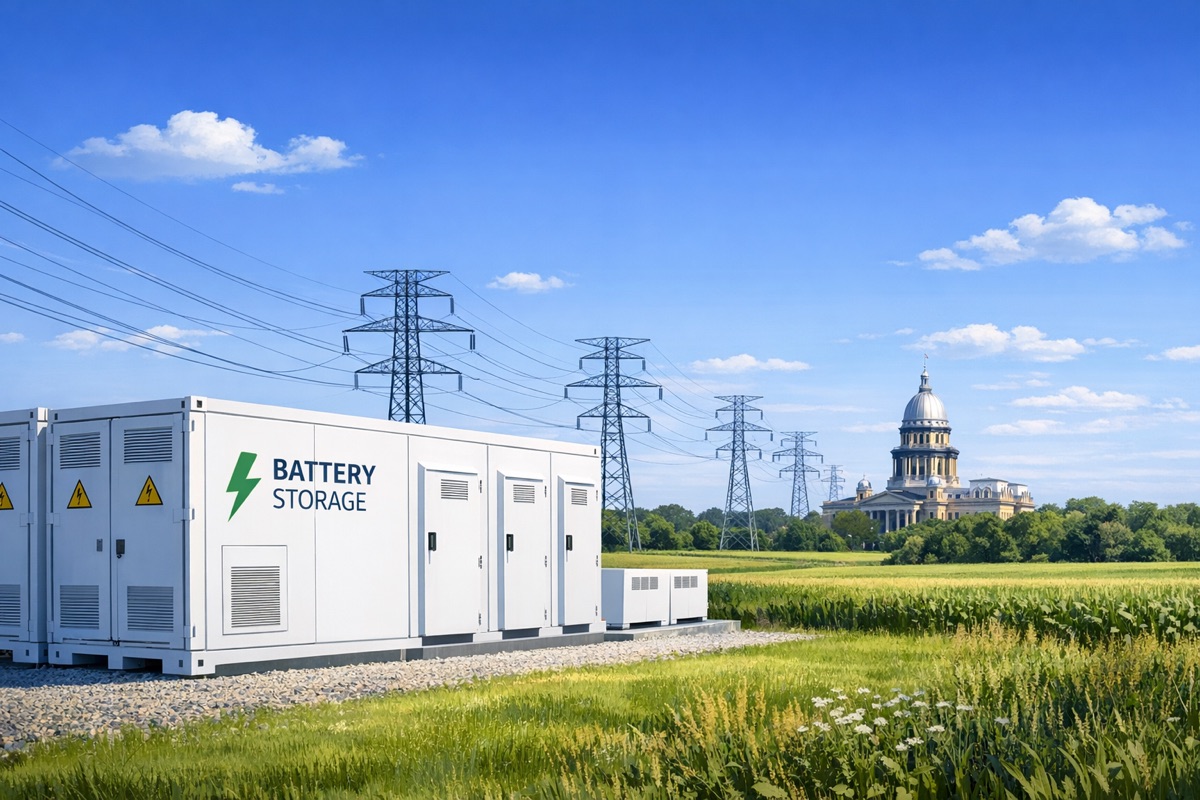
The centerpiece of the CRGA is a mandate for 3 gigawatts of grid-scale battery storage by 2030. The Illinois Power Agency will run the first procurement by the end of August 2026, targeting just over 1,000 MW of 4-hour duration batteries.
Why does this matter for your bill? Battery storage lets the grid absorb cheap electricity when supply is high (overnight, on windy days) and release it during expensive peak hours. More storage means less reliance on expensive "peaker" plants that only run during summer afternoons — the same hours that drive the highest prices on your bill.
Battery Storage Procurement Timeline
3 GW of 4-hour battery storage = enough to power roughly 750,000 homes during peak demand.
The law also creates a "Storage for All" program to bring battery storage benefits to income-eligible households, nonprofits, and public facilities — ensuring the transition doesn't only benefit homeowners who can afford to install their own systems.
Virtual Power Plants: Your Home Battery Can Earn You Money
One of the most exciting provisions for homeowners is the new Virtual Power Plant (VPP) program. A VPP aggregates distributed energy resources — like your rooftop solar panels and home battery — and coordinates them to send stored power back to the grid during high-demand periods. Think of it as a neighborhood-scale power plant, but made up of hundreds of home batteries working together.
VPP Program Key Dates & Details
- June 1, 2026: ComEd and Ameren must file VPP tariffs with the ICC
- June 30, 2026: Short-term VPP program launches — all customer classes eligible
- $250/kWh rebate for battery storage (standalone or paired with solar)
- $10/kW minimum performance payment for each dispatched event
Here's what this looks like in practice: if you install a 10 kWh home battery, you'd receive a $2,500 upfront rebate. Then, each time ComEd dispatches your battery during a peak event, you earn additional performance payments. These stack on top of any Illinois Shines SRECs and property tax exemptions you already qualify for.
The VPP program is available to all customer classes, including residential. You don't need solar panels to participate — standalone battery storage qualifies for the rebate too, as long as the system is under 5 MW and you enroll in the scheduled-dispatch program.
Time-of-Use Rates: Pay Less When You Use Less
The CRGA requires ComEd, Ameren, and alternative retail electric suppliers to offer customers opt-in time-of-use (TOU) rates. Unlike flat-rate billing, TOU rates charge less for electricity during off-peak hours (typically overnight and early morning) and more during peak afternoon hours.
ComEd already offers Hourly Pricing and Time-of-Day Pricing, and participants typically save 15-20%. The CRGA expands this by requiring all investor-owned utilities to offer TOU options, giving Ameren customers the same opportunities to shift usage and save.
If you pair time-of-use rates with a home battery, you can charge the battery overnight when prices are lowest and draw from it during peak hours — or even sell stored energy back through the VPP program.
Doubled Energy Efficiency Targets
The CRGA replaces existing energy efficiency benchmarks with a new annual savings goal: 2% of average annual electricity sales (based on 2021-2023 figures). In practical terms, this roughly doubles Ameren's efficiency programs and increases ComEd's by 25%.
| Utility | New 2% Goal Starts | Program Increase | Key Change |
|---|---|---|---|
| ComEd | 2027 | +25% | Can count up to 30% of savings from gas-to-electric conversions |
| Ameren | 2029 (ramp-up) | ~2x | Can count up to 20% of savings from gas-to-electric conversions |
The law also requires utilities to meet a minimum spending threshold for low-income households and removes the formula rates utilities previously received for administering efficiency programs. Translation: more money goes to actual efficiency work, less to utility overhead.
Nuclear Moratorium Lifted
Illinois enacted a moratorium on new nuclear construction in the late 1980s. The CRGA eliminates that prohibition entirely, including for large reactors over 300 MW. Combined with Governor Pritzker's Executive Order 2026-01 to accelerate nuclear permitting, this opens the door for both traditional large reactors and next-generation small modular reactors (SMRs).
This matters because nuclear already provides 53% of Illinois' electricity from six existing plants. Big Tech has taken notice — Meta signed a 20-year deal with Constellation for the entire output of the Clinton nuclear plant to power AI data centers. With the moratorium lifted, Illinois is positioning itself as a hub for the next wave of nuclear construction.
Thermal Energy Networks: A Pilot for Neighborhood Heating
The CRGA authorizes the Illinois Finance Authority to establish a Thermal Energy Network (TEN) pilot program with up to $20 million in funding. TENs use naturally occurring underground heat, transferred through water-filled pipes, to provide heating and cooling to residential and commercial buildings.
Think of it as a neighborhood-scale geothermal system. Instead of each building running its own furnace or air conditioner, a shared loop of underground pipes handles temperature control for an entire block. The technology isn't new, but deploying it at the neighborhood level with utility backing is a significant step for Illinois.
Illinois' First Integrated Resource Plan
Perhaps the most consequential long-term provision is the creation of a statewide Integrated Resource Plan (IRP). Illinois has never had one. The IRP will be led by the ICC in coordination with the Illinois Power Agency, the Illinois EPA, and the utilities.
The first IRP is due November 15, 2026, with a second by September 30, 2029, and then every four years after that. Each plan must evaluate future electricity needs over 5, 10, 15, and 20-year timelines, including peak demand forecasts and an analysis of all generation options — renewable, nuclear, storage, and conventional.
The IRP also gives the Illinois General Assembly the power to reject ICC rate decisions, adding a layer of political accountability to the rate-setting process that didn't exist before.
CRGA Implementation Timeline
June 1, 2026
CRGA Takes Effect
ComEd and Ameren must file VPP tariffs. Time-of-use rate options become available.
June 30, 2026
VPP Program Launches
Residential customers can enroll in VPP with battery storage. $250/kWh rebates available.
August 2026
First Battery Storage Procurement
IPA procures ~1,000 MW of utility-scale 4-hour battery storage.
November 15, 2026
First Integrated Resource Plan
Illinois' first statewide IRP due to the ICC — a 5-to-20-year grid roadmap.
2027
ComEd Energy Efficiency Targets Increase
ComEd must meet the new 2% annual savings goal. Ameren ramps up to 2% by 2029.
2030
3 GW Storage Target
Full 3 GW of grid-scale battery storage deployed across Illinois.
What This Means for Your Electric Bill
The $13.4 billion savings figure is a 20-year projection. Your bill won't drop in June. But the CRGA creates real, near-term opportunities for households willing to take action:
Install a Home Battery
Claim the $250/kWh VPP rebate (launching June 30), stack it with Illinois Shines SRECs and property tax exemptions, and earn ongoing performance payments when the grid needs your stored energy.
Switch to Time-of-Use Rates
Once the new TOU tariffs are available (June 2026), shift heavy usage — EV charging, laundry, dishwasher — to off-peak hours. Pair with a price tracking tool like Electrac to know exactly when prices are lowest.
Take Advantage of Efficiency Programs
With ComEd and Ameren ramping up efficiency spending, expect expanded rebates for insulation, smart thermostats, heat pump water heaters, and other upgrades in 2027 and beyond.
Watch the IRP Process
The first IRP (due November 2026) will shape Illinois' energy strategy for the next two decades. Public comments will be accepted — this is your chance to weigh in on how the grid evolves.
The Bottom Line
The CRGA doesn't fix Illinois' electricity affordability problem overnight. Capacity prices are still at record levels, data center demand is still growing, and delivery rates are still climbing. But the law puts real infrastructure in place — battery storage, VPPs, stronger efficiency programs, and for the first time, a long-range plan for the grid — that should start bending the cost curve within the next few years.
The provisions that matter most for your wallet start landing in June 2026. If you've been thinking about a home battery, time-of-use pricing, or just want to understand when electricity is cheapest, now is the time to start paying attention.
Track Prices. Shift Usage. Save Money.
Electrac monitors ComEd prices in real-time so you can take advantage of off-peak rates
Get Started with Electrac