Where Does Illinois Get Its Electricity? A Power Generation Breakdown
Nuclear Dominance, Renewable Growth, and the Road to 100% Clean Energy
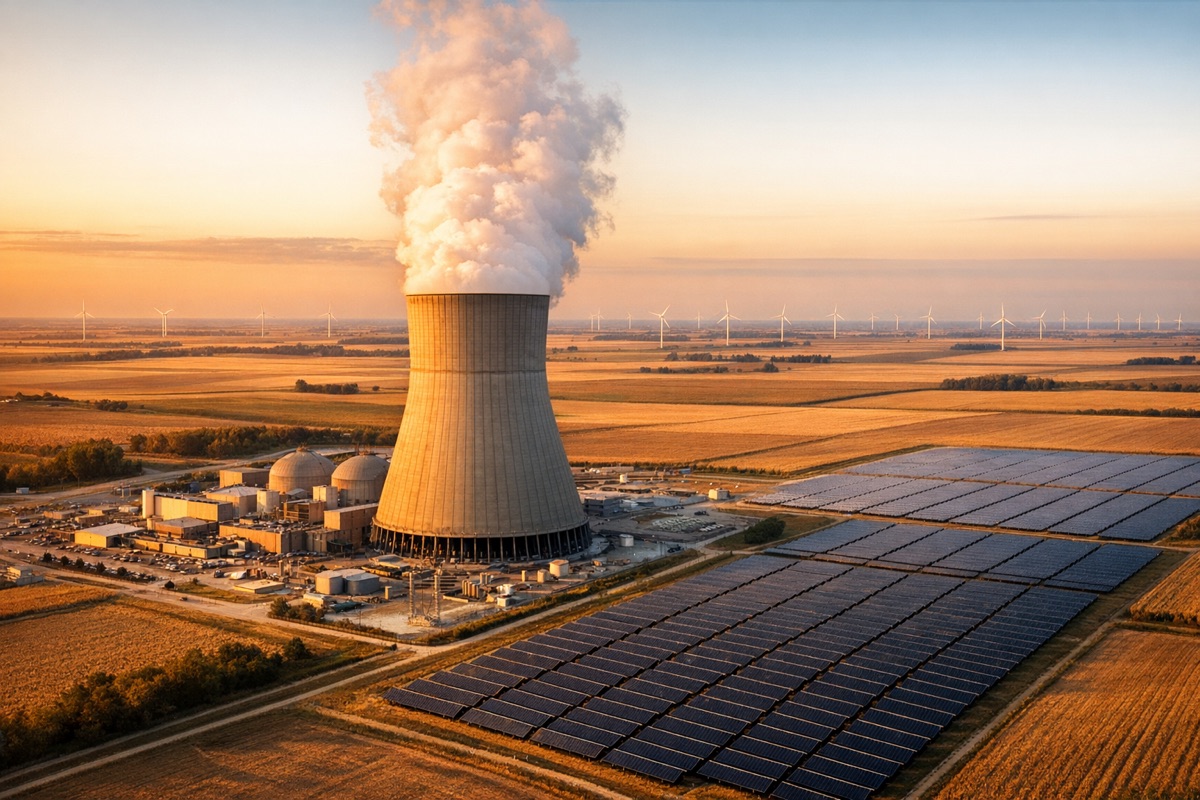
Illinois ranks fifth in the country for total electricity production, generating enough power to export tens of millions of megawatt-hours to neighboring states every year. But the real surprise is how that power gets made. Over half of the electricity generated in Illinois comes from nuclear reactors — more than any other state in the nation.
That fact catches most people off guard. When you think about energy in the Midwest, coal and natural gas probably come to mind first. And while those fuels still play a role, the story of Illinois electricity is really a story about nuclear dominance, a fast-growing renewables sector, and an ambitious state law that's pushing the grid toward 100% clean energy by 2050.
Here's a full breakdown of where Illinois gets its power — and where it's headed.
Illinois Power Generation by Source
Based on 2024 generation data from the U.S. Energy Information Administration, here's how Illinois's electricity production breaks down by fuel source:
2024 Illinois Electricity Generation Mix
Source: U.S. Energy Information Administration, 2024 state electricity generation data
The takeaway is stark: nuclear power alone produces more than three times the electricity of the next largest source. When you combine nuclear with wind and solar, about two-thirds of Illinois's electricity already comes from carbon-free sources.
Nuclear: The Backbone of Illinois Power
Illinois operates six nuclear power plants with eleven reactors, all owned by Constellation Energy (which spun off from Exelon in 2022). Together, they produce about 53% of the state's electricity and roughly one-eighth of all nuclear generation in the entire United States.
That makes Illinois the #1 nuclear power state in America — and it's not particularly close. Pennsylvania, the runner-up, has fewer reactors and less total output.
| Plant | Location | Capacity (MW) | Reactor Type | Online |
|---|---|---|---|---|
| Braidwood | Will County | ~2,386 | PWR (Westinghouse) | 1987–88 |
| Byron | Ogle County | ~2,347 | PWR (Westinghouse) | 1985–87 |
| LaSalle | LaSalle County | ~2,320 | BWR (GE) | 1982–84 |
| Quad Cities | Cordova | ~1,870 | BWR (GE) | 1972–73 |
| Dresden | Grundy County | ~1,845 | BWR (GE) | 1970–71 |
| Clinton | Clinton | ~1,062 | BWR (GE) | 1987 |
| Total | ~11,830 | |||
Historical footnote
Dresden Unit 1, which went online in 1960, was the first full-scale, privately financed nuclear power plant in the United States. Though Unit 1 is now retired, the site is designated a Nuclear Historic Landmark. Units 2 and 3 continue to operate.
These plants run around the clock as "baseload" generators — they produce a steady, reliable stream of power regardless of weather or time of day. That reliability is a big part of why Illinois is a major net exporter of electricity, sending roughly 38 million MWh to neighboring states in 2023 (the third-highest export volume in the country, behind Pennsylvania and Alabama).
Natural Gas: The Growing Runner-Up
Natural gas accounted for about 17% of Illinois electricity generation in 2024 — its highest share ever. A decade ago, gas made up only a fraction of the state's power mix. The rapid growth mirrors a national trend: as older coal plants shut down, natural gas plants have stepped in to fill the gap.
Gas-fired plants are typically used as "peaker" plants that ramp up quickly when demand spikes — during summer heat waves, for example, or when wind generation drops off. They're cheaper and faster to build than coal or nuclear plants, and they produce roughly half the carbon emissions of coal per megawatt-hour.
That said, natural gas isn't part of Illinois's long-term plan. Under the Climate and Equitable Jobs Act (more on that below), all gas-fired power plants in the state must reach zero emissions by December 31, 2045. For now, though, gas remains the flexible workhorse that keeps the lights on during periods of peak demand.
Coal: A Declining Force
Coal generated about 14% of Illinois electricity in 2024. That number has been in free fall — as recently as 2009, coal accounted for 46% of the state's power. Over 9,100 MW of coal capacity has shut down since then.
Coal's Share of Illinois Electricity
2009
46%
2015
35%
2020
20%
2024
14%
Coal's share of Illinois generation has dropped by more than two-thirds since 2009
The largest remaining coal plant is Prairie State Energy Campus in Washington County — a 1,600 MW facility that's also the state's single largest source of air pollution. It's owned by a consortium of nine public power agencies serving municipal utilities across eight states. Several communities, including Naperville and St. Charles, have already announced they won't renew their contracts with Prairie State past 2035.
Under CEJA, all privately owned coal plants must reach zero emissions by January 1, 2030. Municipal coal plants like Prairie State have until 2045, but market forces and local politics may push closures earlier.
Wind Power in Illinois: 10 GW and Climbing
Wind energy supplied about 13% of Illinois electricity in 2024, making it the state's largest renewable source. Illinois had over 10,300 MW of installed wind capacity across 99 projects as of early 2025, ranking it fifth nationally in utility-scale wind generation.
Wind accounts for roughly 83% of all renewable generation in the state. That capacity has nearly doubled since 2019, when Illinois had around 5,200 MW of wind online. Another 1,400 MW of wind projects are scheduled to come online by 2027.
Most of Illinois's wind farms are concentrated in the central and northern parts of the state, where the flat terrain and consistent winds make for strong capacity factors. If you've driven through central Illinois on I-55 or I-39, you've seen them — rows of turbines stretching across the agricultural landscape.
Solar: The Fastest-Growing Source
Solar is still a small slice of the overall pie — roughly 2% of generation in 2024 — but its growth trajectory is dramatic. Illinois had just 80 MW of solar capacity before 2017. By early 2025, that number had exploded to over 6,100 MW across 120,000+ projects.
The state nearly doubled its solar capacity in 2024 alone, adding 2.5 GW in a single year. Illinois ranked third nationally for residential solar installations in the fourth quarter of 2024, behind only California and Florida. The largest single project is the Double Black Diamond solar farm near Springfield, a roughly 600 MW facility that came online in late 2024.
If you're considering going solar in Illinois, the combination of state incentives, federal tax credits, and net metering credits makes the economics increasingly attractive.
Solar capacity growth
80 MW (pre-2017) → 3,500 MW (2023) → 6,100+ MW (early 2025). At the current pace, solar could overtake coal as a generation source within the next few years.
CEJA: Illinois's Roadmap to 100% Clean Energy
The Climate and Equitable Jobs Act (CEJA), signed into law on September 15, 2021, made Illinois the first Midwest state to mandate a carbon-free power grid. It sets a series of escalating deadlines that are already reshaping the state's energy landscape:
CEJA Key Deadlines
All private coal and oil plants must reach zero emissions. State targets 40% renewable energy procurement.
Municipal coal plants must achieve a 45% emissions reduction.
50% renewable energy procurement target statewide.
All fossil fuel plants — including natural gas and municipal coal — must reach zero emissions.
100% clean energy target for the entire state.
CEJA isn't just about closing fossil fuel plants. It also established workforce transition programs for displaced energy workers, created the Energy Community Reinvestment Act for affected towns, and set up incentive structures that have fueled the solar and wind boom described above.
What's Next: New Nuclear and the AI Power Demand
For nearly 40 years, Illinois had a moratorium on building new large nuclear reactors — ironic for the state that depends on nuclear more than any other. That moratorium was finally lifted in January 2026, and Governor Pritzker signed an executive order targeting 2 GW of new nuclear capacity with construction beginning by 2033.
Constellation Energy, which owns all six existing plants, is already investing $800 million to uprate the Braidwood and Byron plants, adding roughly 135 MW of capacity by 2029. The company is also exploring building a small modular reactor (SMR) at the Clinton site.
Meanwhile, the growing demand from AI data centers is driving new interest in nuclear power. Constellation and Meta signed a 20-year power purchase agreement for Clinton's full output (~1,121 MW) to power Meta's data center operations with carbon-free energy. That deal signals a broader trend: tech companies are willing to pay premium prices for the kind of reliable, clean baseload power that only nuclear can provide at scale.
The Clinton cost overrun
When Clinton Power Station was proposed in the 1970s, the estimated budget was $430 million. By the time it came online in 1987, the final cost was $4.25 billion — nearly 1,000% over budget and seven years behind schedule. Exelon later bought the plant for just $40 million. Today, its output is contracted to Meta for the next two decades.
What This Means for Your Electricity Bill
Illinois's heavy nuclear base has historically kept wholesale electricity prices lower and more stable than in states that rely heavily on natural gas. Nuclear plants have essentially zero fuel cost volatility — unlike gas plants, where your bill can spike when pipeline prices surge during a cold snap.
But the energy transition brings its own cost dynamics. Building out renewable capacity, upgrading transmission lines, and managing grid reliability as coal plants retire all add costs. The growing demand from data centers is also pushing capacity auction prices higher, which ultimately flows through to consumer electricity bills.
For ComEd customers on hourly pricing, the generation mix has a direct impact on what you pay. Hours when wind is blowing strong tend to push wholesale prices down. Hours when gas peaker plants kick in tend to push prices up. Understanding the generation mix helps explain why prices behave the way they do.
The Bottom Line
Illinois's power grid is anchored by the largest nuclear fleet in the country — six plants producing over half the state's electricity. Wind and solar are growing fast, while coal continues a steep decline. Natural gas fills the gaps but is itself on a legislated path to retirement. And with CEJA's deadlines approaching and new nuclear investment on the horizon, the state's generation mix will look meaningfully different by 2035.
For anyone tracking electricity prices in Illinois, the composition of the grid is worth understanding. It shapes wholesale prices, influences rate structures, and determines how vulnerable your bill is to fuel cost swings. The more you know about where your power comes from, the better you can plan around it.