Net Metering in Illinois: How It Works & 2025 Changes
Understanding Solar Credits for ComEd Customers
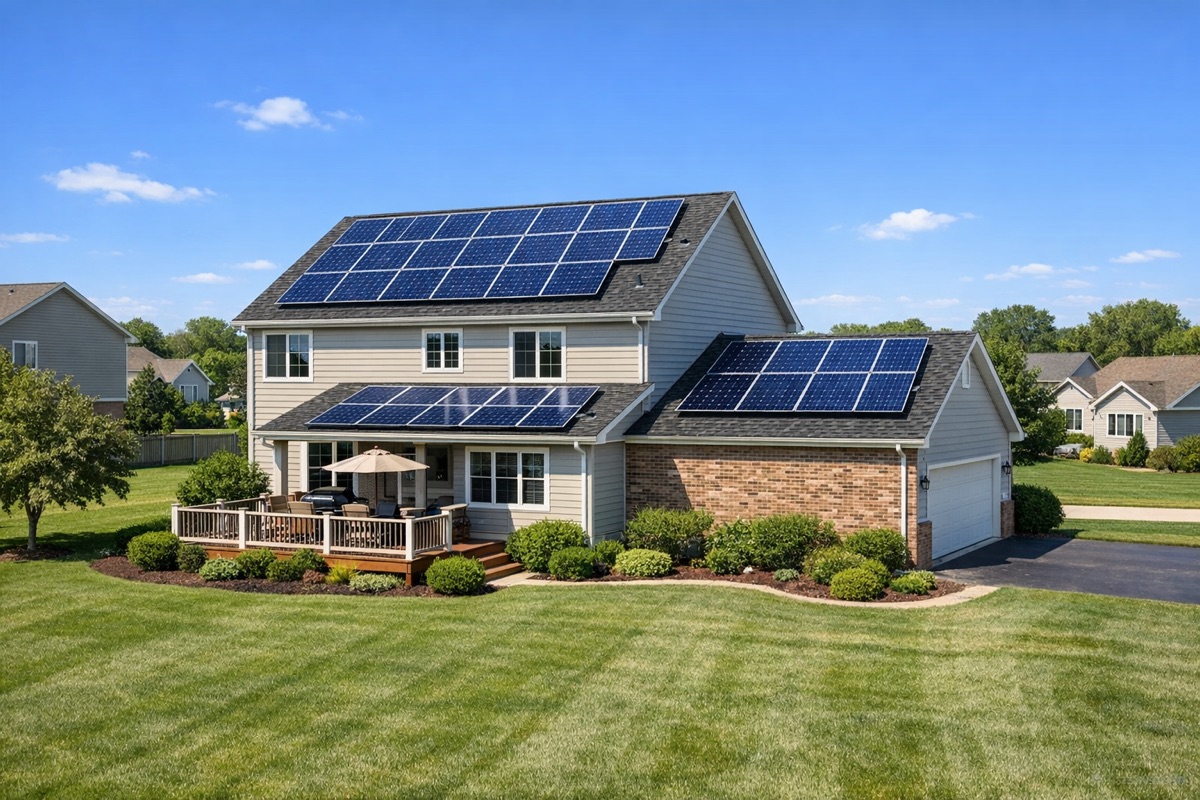
Net metering is the billing arrangement that makes rooftop solar financially viable for most homeowners. When your panels generate more electricity than you're using, you send the excess to the grid and receive a credit on your bill. But in Illinois, the rules changed significantly on January 1, 2025—and if you're considering solar or already own a system, understanding these changes is essential.
What Is Net Metering?
Net metering is a billing mechanism that allows solar panel owners to receive credit for electricity they generate but don't immediately use. Here's the basic flow:
- Generate: Your solar panels produce electricity during daylight hours.
- Use: Your home consumes that electricity in real-time—running your AC, refrigerator, lights, and appliances.
- Export: When production exceeds consumption (common on sunny afternoons), the excess flows out to the electric grid.
- Credit: Your utility records this export and credits your account. The meter literally spins backward.
- Draw: At night or on cloudy days when your panels aren't producing enough, you pull electricity back from the grid.
- Net: At billing time, you pay only for your "net" usage—what you consumed minus what you exported.
How Net Metering Works
The key benefit: you can bank credits during sunny months to offset usage during cloudy or winter months. This makes solar economically viable even in places with variable weather.
Net Metering in Illinois: A Brief History
Illinois has had net metering laws since 2007, but the program really took off after the Future Energy Jobs Act (FEJA) in 2016 and the Climate and Equitable Jobs Act (CEJA) in 2021. CEJA is also driving a massive transformation in how Illinois generates its electricity, with coal plants closing and renewables expanding rapidly.
For years, Illinois offered what's called "full retail rate" or "1-for-1" net metering. Under this system, every kilowatt-hour (kWh) you sent to the grid earned you a credit equal to the full retail price of electricity—including both the supply charge (the cost of the actual electricity) and the delivery charge (the cost of transmitting it to your home).
This was extremely favorable for solar owners. If you exported 1 kWh at noon and imported 1 kWh at midnight, you broke even—no cost to you. The utility essentially used your solar power during the day and gave it back at night.
The 2025 Change: Supply-Only Net Metering
The Climate and Equitable Jobs Act (CEJA) included a major change to net metering that took effect on January 1, 2025. For new solar installations interconnected after that date, Illinois switched from full retail net metering to supply-only net metering.
What Changed
Under the new rules, when you export electricity to the grid, you only receive a credit for the supply portion of your bill—not the delivery charges, taxes, or fees. When you import electricity back, you still pay the full retail rate (supply + delivery + everything else).
Understanding Supply vs. Delivery
Your ComEd bill has two main components:
- Supply charges: The cost of the actual electricity (the commodity). This typically makes up 50-65% of your bill and is currently around 9-10 cents per kWh.
- Delivery charges: The cost of transmitting electricity over ComEd's wires to your home, plus taxes and fees. This makes up the remaining 35-50% of your bill.
You also probably notice other fees and charges, learn more about how to read your ComEd bill.
Net Metering Credit Value Comparison
Credit value per kWh exported to the grid
*Based on average ComEd rates in 2024. Actual rates vary by season and rate plan. ComEd's supply rate has since risen sharply (to 10.399¢/kWh for summer 2026), so current supply-only credit values run higher than the figure shown — but the supply-vs-retail gap that makes self-consumption valuable remains.
Why This Matters Financially
Under full retail net metering, exporting and importing the same amount of electricity was a wash—you paid nothing extra. Under supply-only, there's an asymmetry:
That means every kWh you export and later import back costs you roughly 7.5 cents. This changes the optimal strategy: instead of maximizing exports, you now want to maximize self-consumption—using or storing the power you generate rather than sending it to the grid.
Grandfathering: Who Keeps Full Retail Net Metering?
If your solar system was fully installed, inspected, and interconnected before January 1, 2025, you're "grandfathered" into the old full retail net metering program. This means:
- You continue receiving credits for supply, delivery, and all other charges
- This protection lasts for the life of your system (typically 25+ years)
- It applies as long as you don't significantly modify or expand your system
ComEd required customers to submit their Certificate of Completion and Witness Test Request by December 31, 2024 (extended from an original December 13, 2024 deadline), and to receive Permission to Operate by year-end. If you made that deadline, you're locked in.
The Smart Inverter Rebate: Illinois's Compensation
Recognizing that the net metering change reduces the value of solar, CEJA also created a new incentive: the Distributed Generation (DG) Rebate, commonly called the Smart Inverter Rebate.
Smart Inverter Rebate Details
For an 8 kW system: $2,400
For a 13.5 kWh battery: $4,050
Combined, a typical solar + battery system could receive $6,000+ in DG rebates.
To qualify, your system must include a "smart" inverter capable of two-way communication with the grid. Most modern inverters from brands like SolarEdge, Enphase, Tesla, and Generac qualify. Note that to receive the battery storage rebate, ComEd customers must enroll in ComEd's Hourly Pricing program.
Credit Rollover: A Silver Lining
One positive change under CEJA: net metering credits now roll over indefinitely. Previously, credits expired at the end of a 12-month billing cycle (typically April or October, depending on when you enrolled).
Now, if you build up substantial credits during sunny summer months, you can carry them forward year after year until you use them. This is particularly helpful for homeowners who over-produce in summer but don't want to lose those credits.
How Net Metering Works with Hourly Pricing
If you're on ComEd's Hourly Pricing program (Rate BESH), net metering works slightly differently—and potentially more favorably.
Instead of receiving a flat per-kWh credit, your exports are valued at the real-time hourly price at the moment you export. This creates opportunities:
- High-value exports: On hot summer afternoons when prices spike (sometimes to 20-30+ cents per kWh), your solar exports are worth more.
- Strategic timing: With a battery, you can choose when to export—sending power to the grid during price spikes and storing it during low-price periods.
- Negative prices: Occasionally, wholesale prices go negative. With a battery, you can stop exporting and even charge from the grid while getting paid.
Tracking real-time prices becomes important. Tools like Electrac can help you monitor hourly rates and understand when your exports are most valuable.
Hourly Pricing + Solar Savings
According to ComEd, Hourly Pricing participants with net metering have saved an average of 30% on energy supply costs compared to the fixed-price rate—double the 15% average for Hourly Pricing customers without solar.
System Size Limits and Requirements
Illinois net metering has specific rules about system size:
- Maximum size: 2,000 kW (2 MW) for a single system
- Production limit: Your system cannot produce more than 110% of your previous 12 months of energy consumption
- ComEd recommendation: Size your system to meet 80-90% of your annual usage for optimal economics
These limits ensure net metering remains a tool for offsetting personal consumption rather than turning homes into commercial power plants.
Batteries: The New Essential for Illinois Solar
Under full retail net metering, batteries were nice-to-have—primarily for backup power during outages. Under supply-only net metering, batteries become economically essential.
Here's why: without a battery, excess solar production gets exported at the supply-only rate (~6.8¢/kWh). Later, you buy that same energy back at the full retail rate (~14.3¢/kWh). You lose money on every kWh that round-trips through the grid.
With a battery, you can:
- Store excess solar production during the day
- Use that stored energy in the evening when your panels aren't producing
- Avoid the supply-delivery spread entirely
- Provide backup power during grid outages
For a deeper dive into how batteries and other equipment fit into a modern Illinois solar installation, see our guide to getting started with solar in Illinois.
Other Illinois Solar Incentives
Net metering is just one piece of the Illinois solar puzzle. Other programs that stack with net metering include:
Illinois Shines (Adjustable Block Program)
This state program pays you for Solar Renewable Energy Credits (SRECs) over 15 years. For residential systems, this can amount to 20-25% of your system cost, paid either as a lump sum or over several years.
Illinois Solar for All
Income-eligible households can receive additional incentives through this program, which received increased funding under CEJA ($70 million annually, up from $30 million).
Federal Tax Credit Status
Note that federal incentives have changed. The 30% Residential Clean Energy Credit (Section 25D) was eliminated by the One Big Beautiful Bill Act (signed July 4, 2025) for any system whose installation was not completed by December 31, 2025. The cutoff is based on the installation-completion date — not your purchase or contract date — and there is no step-down period. As of mid-2026, the credit has expired for residential systems completed this year. However, systems financed through leases or PPAs may still benefit from the commercial tax credit through the installation company.
Is Solar Still Worth It in Illinois?
Despite the net metering changes, solar remains a strong investment in Illinois for several reasons:
- Rising electricity costs: ComEd rates have increased significantly, with supply prices jumping nearly 50% in 2025 due to capacity auction results. Higher rates mean more savings from self-generated power.
- State incentives remain strong: Illinois Shines SRECs and DG rebates help offset the reduced net metering value.
- Battery economics improve: As battery prices continue to fall, the self-consumption strategy becomes more attractive.
- Environmental impact: A typical home system still offsets 4-5 metric tons of CO2 annually.
The calculation has shifted from "maximize grid exports" to "maximize self-consumption with strategic exports during high-price periods." With proper system design (including battery storage), solar can still provide excellent returns.
The Bottom Line
Net metering in Illinois changed substantially on January 1, 2025. The shift from full retail to supply-only credits means new solar customers receive roughly half the credit value for their exports compared to the old system.
However, this doesn't make solar uneconomical—it changes the optimal strategy. Battery storage has become essential rather than optional, and timing your energy use (and exports) to match price signals becomes more valuable. Combined with Illinois's other incentives, solar remains a solid long-term investment.
If you're considering solar, focus on:
- Including battery storage in your system design
- Enrolling in ComEd's Hourly Pricing program
- Working with an Illinois Shines Approved Vendor to capture all available incentives
- Sizing your system for self-consumption rather than maximum export
The rules have changed, but the opportunity remains.